There is no trustworthy single number for “world average screen time”, and the ones that circulate mostly trace back to nobody. What is measured: internet users aged 16 and over report 4h 47m a day online (DataReportal Digital 2026), of which 2h 39m is social media. US teens aged 13-18 average 8h 39m a day of entertainment screen media, excluding school work (Common Sense Media, 2021 census). Almost everyone guesses lower than their own Screen Time report shows.
This page is the how much side of the picture: hours by age, where the hours actually go, and the daily target health guidance points to. For what those hours cost you, see the phone addiction statistics for 2026.
Global Screen Time Statistics in 2026
Read these with their scope attached, because scope is where most screen-time statistics fall apart. Every figure below is self-reported unless it says otherwise, covers internet users rather than whole populations, and measures time online rather than every minute a screen is lit.
Screen Time by Age Group
Not surprisingly, younger demographics lead in screen time, but the gap is narrowing as older adults spend more time on devices too:
- US teens (13-18): 8h 39m a day of entertainment screen media, excluding school and homework use (Common Sense Media, 2021 census). That is up from 7h 22m in the same survey's 2019 edition.
- US tweens (8-12): 5h 33m a day on the same measure, up from 4h 44m in 2019.
- Adults: there is no equivalent census. Published adult numbers come from commercial panel surveys with no consistent definition of a screen, and they disagree with each other by hours. We have removed the per-band adult figures this page used to carry rather than repeat numbers we cannot source.
Your own iPhone Screen Time report is a better number than any of these for your own life, because it is measured rather than remembered.
Where Does All That Screen Time Go?
Understanding how people spend their screen time is just as important as the total:
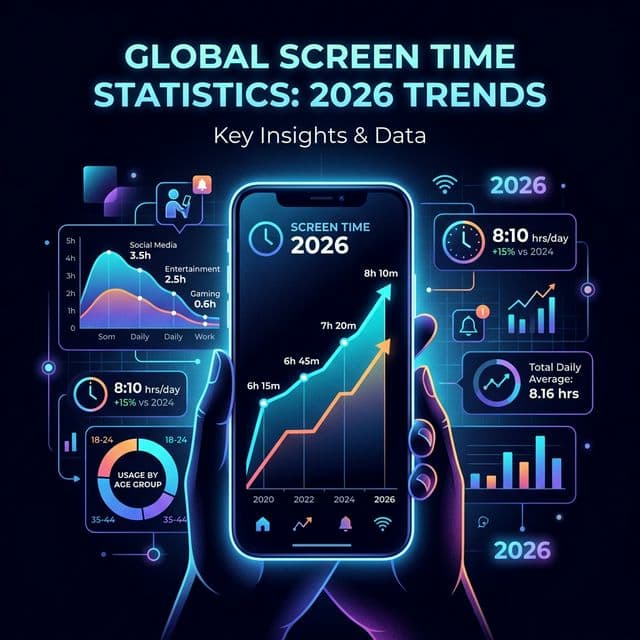
The only category split we can source is social media: 2h 39m a day among internet users aged 16 and over (DataReportal Digital 2026 (GWI, Q2 2025 data)). The per-category breakdown this page used to publish — streaming, messaging, gaming and productive use, each to the minute — had no publisher behind it, so it has been removed rather than dressed up with a citation.
The Social Media Time Tax
What Those Hours Cost
The health picture is a separate subject and it deserves its own page rather than a bullet list here: the research links heavy use to anxiety and depression, disrupted sleep, shrinking attention spans and comparison-driven inadequacy, alongside physical effects like digital eye strain and the posture problems people call "text neck". We cover all of it, with the figures, in the phone addiction statistics for 2026 — and the sleep half specifically in screen time and sleep.

How Much Screen Time Is Healthy?
Less prescriptively than most articles claim. The American Academy of Pediatrics withdrew its blanket hour limits for children over five years ago in favour of a family media plan, and there is no credible expert body publishing a daily recreational screen-time cap for adults at all.
- Under 2: the AAP advises avoiding screen media other than video chat.
- Ages 2 to 5: the AAP suggests about one hour a day of high-quality programming, watched together where possible.
- Ages 6 and up: no fixed number. The AAP asks families to set consistent limits that protect sleep, physical activity and time together.
- Adults: no official guideline exists. The useful question is not how many hours, but how many of them you chose.
Quality vs. Quantity
Bringing the Number Down
Knowing the average does not move your own number. What moves it is a handful of concrete changes: track a baseline week before you set a target, cut it by thirty minutes at a time rather than all at once, make the bedroom and the dinner table phone-free, switch the display to grayscale so the pull is weaker, and put something physical between you and the app you open without deciding to. Our step-by-step guide to limiting screen time on iPhone walks through the native settings, and the reduce screen time page covers the exercise-gated version of the same idea.
Key Takeaways
Screen time keeps climbing, and the honest summary is narrower than the headline numbers suggest: internet users report 4h 47m a day online, teenagers report far more entertainment screen media than that, and nobody has a reliable figure for everyone on earth. The health implications are real, and small deliberate changes do move them.
Start by tracking your current screen time for a week, then decide which of those hours you actually chose. The ones you did not choose are the ones worth putting a price on.